
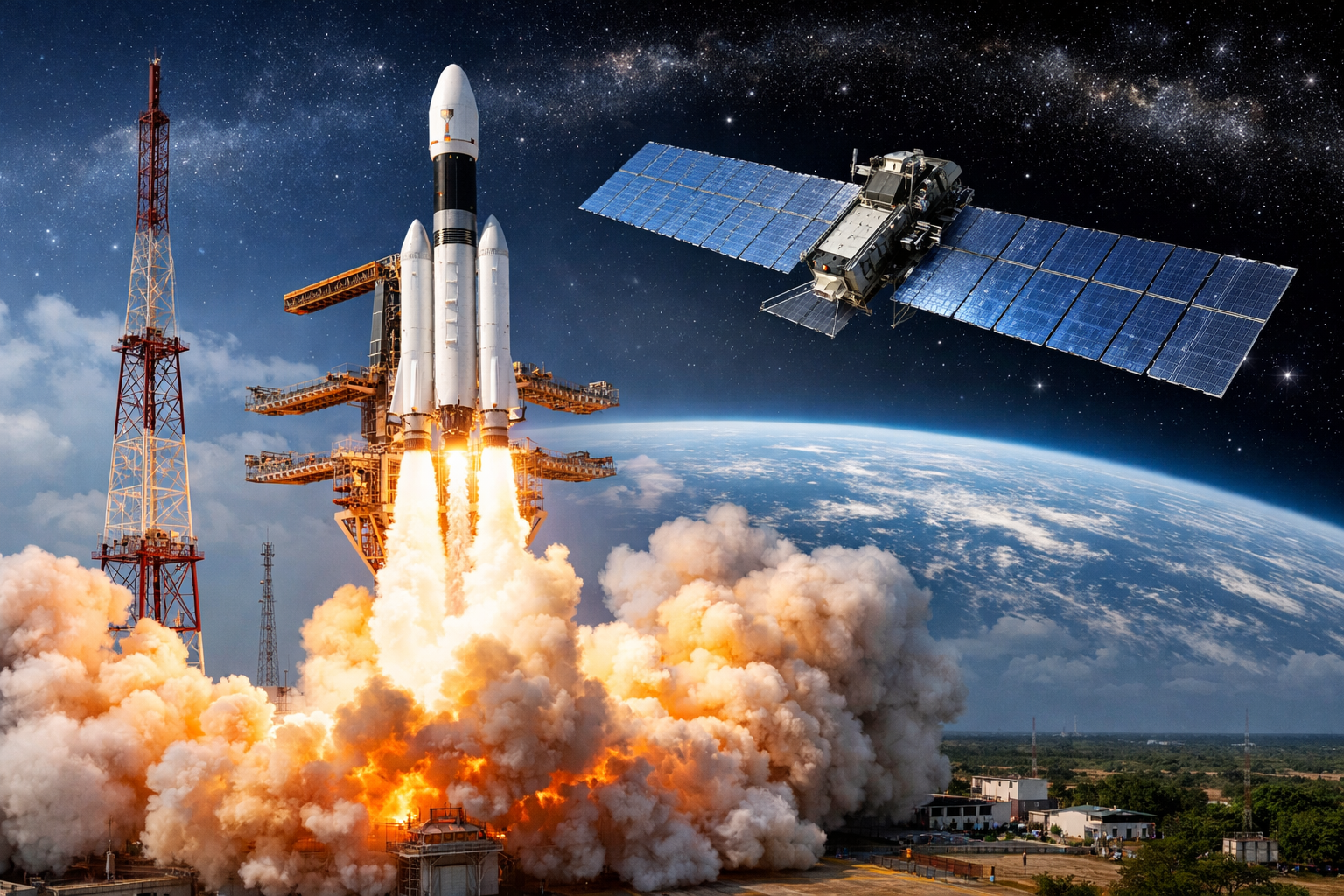
AST SpaceMobile Inc. has moved closer to offering space-based mobile connectivity by launching its largest satellite to date from India, said a Bloomberg report, marking a significant step in its global deployment strategy.
The deployment marks a milestone for the Texas-based company as it seeks to challenge Elon Musk’s SpaceX in the rapidly developing market for direct-to-device satellite communications.
Largest AST satellite reaches orbit aboard ISRO rocket
The BlueBird 6 satellite lifted off at 8:55 a.m. local time from the Satish Dhawan Space Center in southern India.
The spacecraft was carried aboard the Indian Space Research Organization’s LVM3 rocket and reached low-Earth orbit in about 16 minutes, according to the livecast streamed on YouTube.
For AST SpaceMobile, the successful launch represents its most ambitious deployment so far.
The company already has five smaller commercial satellites in orbit, but BlueBird 6 is the first of a new generation designed to support wider coverage and improved performance.
AST plans to launch as many as 60 additional next-generation satellites in 2026, significantly expanding its constellation.
This mission adds to the LVM3’s expanding track record, which already includes launches of Chandrayaan-2, Chandrayaan-3, and two OneWeb missions that together deployed 72 satellites.
The successful flight further supports India’s broader ambitions in space, including plans to develop its own orbital space station alongside other large-scale projects.
Direct-to-device strategy
AST SpaceMobile is developing a satellite system designed to work alongside standard cellular networks.
Rather than relying on specialised satellite phones, the company aims to connect ordinary mobile devices directly to satellites when terrestrial coverage is unavailable or limited.
To that end, AST has signed partnerships with several major telecommunications providers, including AT&T Inc., Verizon Communications Inc., and Vodafone Group Plc, among others.
These agreements are intended to integrate satellite-based connectivity with conventional cellular services, rather than requiring specialized devices.
The company expects its service to become operational in parts of the United States and four other countries in early 2026, assuming further deployments proceed as planned.
The direct-to-device segment is becoming increasingly competitive, with SpaceX’s Starlink pursuing a similar approach through its partnership with T-Mobile US Inc.
Investor interest and competitive backdrop
AST SpaceMobile’s progress has drawn significant attention from investors.
The company went public in April 2021 through a merger with special purpose acquisition company New Providence Acquisition Corp.
Since then, its shares have seen sharp movements tied to development milestones and broader enthusiasm around satellite communications.
As of the close of trading on Tuesday, AST SpaceMobile’s stock price had risen by about 300% this year, reflecting optimism about its technology and market potential.
The successful launch of BlueBird 6 may further bolster confidence, though the company still faces execution risks as it works toward deploying a full constellation and beginning commercial operations.
The competitive landscape remains intense, with SpaceX’s Starlink already operating a large satellite network and expanding into mobile connectivity.
Against that backdrop, AST’s latest launch highlights both the opportunities and challenges facing newer entrants as they seek to carve out a position in the evolving space-based communications market.
The post AST SpaceMobile launches largest satellite to advance direct-to-device connectivity appeared first on Invezz