
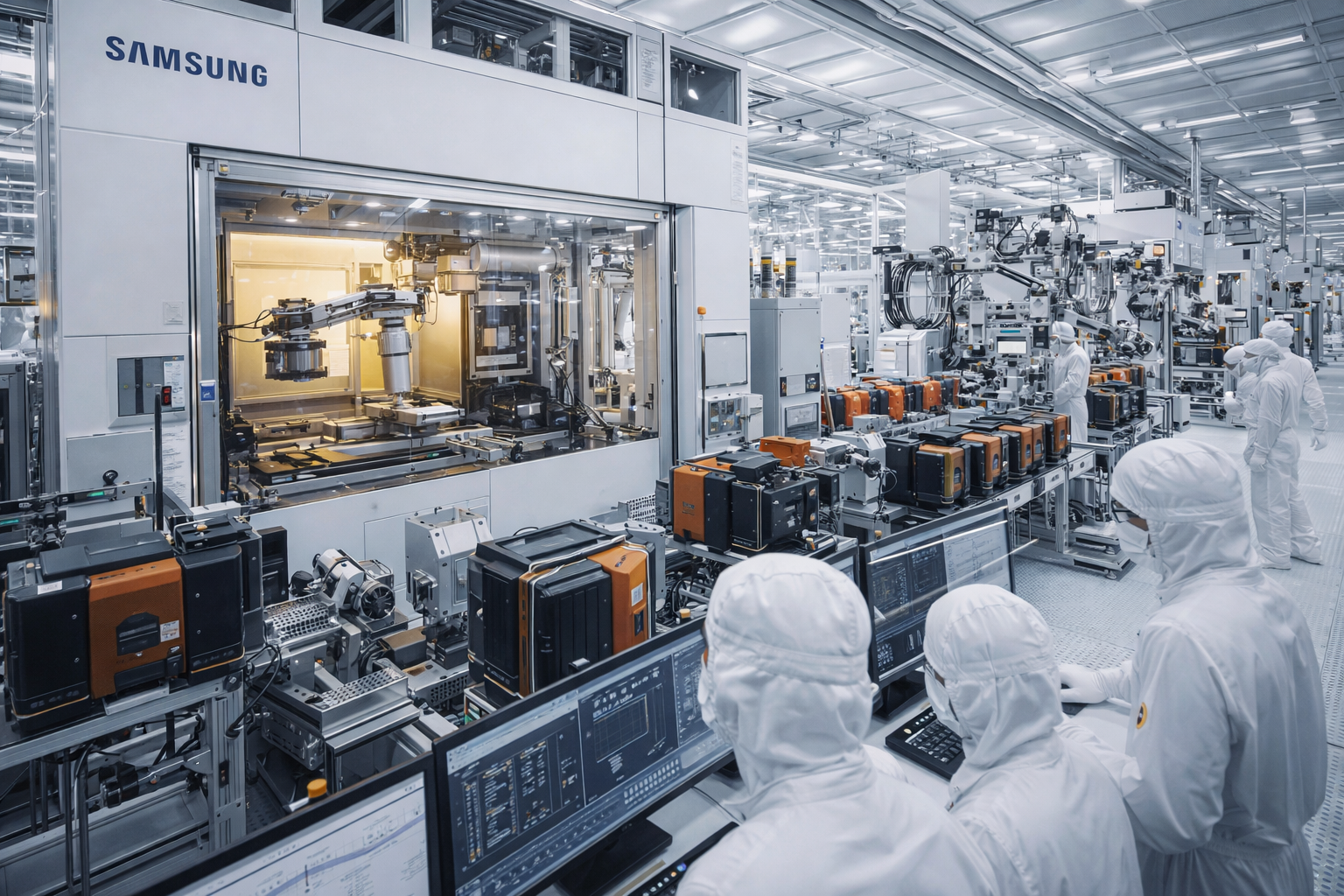
Samsung is making a statement that goes well beyond routine spending.
The company said it plans to spend more than 110 trillion won, or about $73.3 billion, on capital expenditure and research in 2026.
The massive amount underscores how aggressively Samsung is planning to push both its AI memory business and its struggling foundry operation at the same time.
The timing matters because Nvidia CEO Jensen Huang confirmed that Samsung is manufacturing Nvidia’s new AI chips.
Inside Samsung’s chip supercycle
Samsung has not publicly broken out every 2026 line item in detail.
But, its latest financial details reveal some details about Samsung’s priority as the company spent 52.7 trillion won on facilities and 37.74 trillion won on R&D in 2025.
Nearly 90% of that capex went to the Device Solutions semiconductor division.
Those numbers help explain the shape of the 2026 plan.
Samsung is funneling investment into expanding production infrastructure around its Pyeongtaek campus.
Moreover, the company is securing additional EUV lithography tools and building out advanced research capacity.
Samsung announced in February that it had begun mass production of commercial HBM4, which is the next generation of high-bandwidth memory used in AI servers.
Co-CEO Jun Young-hyun is framing that buildout as a response to something bigger than a normal upcycle.
Jun told shareholders he expected strong chip demand through 2026 as AI investment keeps accelerating and described the conditions as a rare supercycle driven by data-center buildouts and memory demand.
Why Nvidia changes the story
Samsung shares rose as much as 5% after Nvidia’s CEO said Nvidia’s new AI chips were being made by the South Korean company.
That is significant because Samsung’s foundry business has been the weak link in the company’s semiconductor story.
Analysts saw Huang’s comments as evidence that the division could be poised for recovery after posting heavy losses in recent years.
Samsung is also trying to make its memory business less volatile.
As per the sources present at the shareholders meeting, the company is considering shifting from quarterly or annual memory agreements to contracts lasting three to five years.
Who should worry?
The most obvious rival under pressure is SK Hynix.
Samsung’s commercial HBM4 rollout directly challenges SK Hynix in the most lucrative part of the AI memory market.
TSMC should also pay attention, though not panic.
Samsung’s Taylor, Texas fab is reported to be nearing a key EUV “first light” milestone this month and could begin risk production in the second half of the year.
The fab will provide Samsung with a more credible US manufacturing base, just as TSMC is guiding for roughly 30% revenue growth in 2026 on AI demand.
Intel Foundry arguably faces the most uncomfortable positioning of all.
Industry analysis shows Intel is still in the early stages of winning major external foundry customers, leaving it squeezed between TSMC’s scale and Samsung’s willingness to spend.
The post Samsung is spending $73B on chips in 2026: who should be worried? appeared first on Invezz